
Single News
Woven Rattan Baskets Manufacturer Guide: How High-Quality Production Impacts Durability and Market Value

In today’s global home storage and interior design market, woven rattan baskets have shifted from simple household containers to high-demand lifestyle and eco-design products. Driven by sustainability trends, minimalist interiors, and the rapid growth of e-commerce retail, search interest around natural fiber storage solutions continues to rise across Google, Pinterest, and design platforms.
For manufacturers and suppliers, this is no longer just a craft product category—it is a structured supply chain industry where material selection, production precision, and OEM capability directly influence brand competitiveness and buyer trust.
Table of Contents
Introduction

The rising popularity of woven storage solutions is closely linked to the global shift toward eco-friendly, plastic-free home organization products.
According to sustainability discussions in industry research, natural fiber products like rattan are increasingly preferred due to their biodegradability, renewable sourcing, and low environmental impact compared to synthetic alternatives .
At the same time, interior design trends show strong demand for boho, Scandinavian, and minimalist aesthetics, where natural textures play a central role in visual styling.
From a manufacturing perspective, this trend is not only consumer-driven—it is supply-chain driven, where factories capable of stable quality output gain long-term wholesale partnerships.
What Are Woven Rattan Baskets Made Of? Material Structure Explained
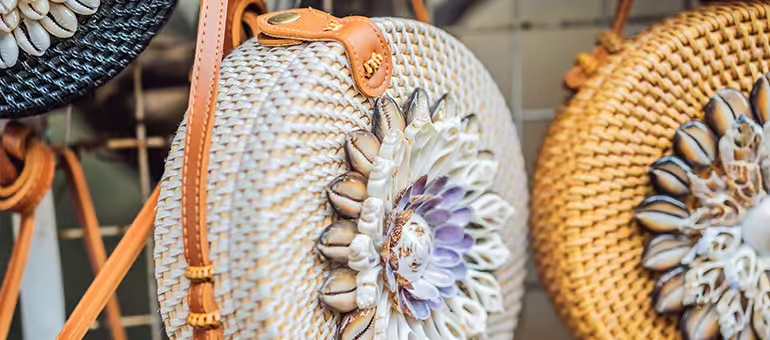
Woven rattan baskets are primarily made from natural rattan cane, a climbing palm native to tropical regions. It is widely recognized for being both flexible and strong, making it ideal for weaving durable structures .
Key material characteristics:
- Natural plant-based fiber
- High flexibility for hand weaving
- Strong tensile performance for structural stability
- Biodegradable and eco-friendly lifecycle
Unlike synthetic storage bins, rattan does not rely on industrial polymer processing, making it a preferred material in sustainable product development discussions .
Inside a Woven Rattan Baskets Manufacturer: Production Workflow

High-quality manufacturing is not just about weaving—it is a controlled multi-stage process.
Core production stages:
1. Raw Material Selection
- Mature rattan cane selection
- Removal of low-grade or brittle fibers
- Sorting based on diameter and flexibility
2. Treatment & Preparation
- Drying under controlled humidity
- Soaking to restore flexibility
- Anti-mold natural treatment processes
3. Hand Weaving / Structural Forming
- Traditional weaving techniques passed through generations
- Structural shaping (round, square, oval, rectangular)
- Reinforced edge binding for load stability
4. Finishing & Surface Treatment
- Natural polishing or light coating
- Color adjustment for uniform appearance
- Final trimming and quality inspection
Industry references confirm that weaving methods significantly influence both aesthetics and structural resilience of the final product .
Why Manufacturing Quality Determines Product Value in Global Markets
In global trade, buyers do not purchase “baskets”—they purchase consistency, durability, and brand compatibility.
Key quality factors include:
- Weaving density and uniformity
- Load-bearing capability
- Structural symmetry
- Surface finishing consistency
Research on woven structures shows that weaving geometry can directly affect stiffness and long-term resilience under repeated use, making craftsmanship a functional engineering factor rather than just aesthetics .
Woven Rattan Baskets Wholesale Market Trends (2026 Perspective)
The global market is shifting toward:
- Natural home storage solutions replacing plastic bins
- Growth in eco-conscious consumer behavior
- Strong demand from e-commerce sellers and retail chains
- Expansion of minimalist interior design markets
Industry reports highlight increasing consumer preference for natural texture and sustainable storage alternatives in modern households .
This trend is particularly strong in:
- Home organization sector
- Boutique interior decoration
- Hospitality and lifestyle retail markets
Woven Rattan Baskets vs Plastic Storage Solutions
The comparison between natural rattan and plastic storage is now a key SEO-driven search topic.
Environmental perspective
Rattan is renewable and biodegradable, while plastic storage contributes to long-term environmental waste issues.
Functional perspective
- Rattan: breathable, lightweight, natural texture
- Plastic: rigid, non-breathable, industrial appearance
Design value
Natural baskets are widely used in modern interior styling due to their ability to add warmth and texture to spaces, especially in minimalist environments.
Custom Woven Rattan Baskets (OEM & Private Label Manufacturing)

For global buyers and brands, customization capability is a key supplier selection factor.
Manufacturers typically offer:
- Custom sizes and structural designs
- Private label branding solutions
- Packaging customization for retail channels
- Product line development for home storage categories
OEM production allows brands to integrate woven baskets into their own product ecosystems without investing in in-house manufacturing infrastructure.
How to Choose a Reliable Woven Rattan Baskets Supplier
Selecting the right manufacturer requires more than price comparison.
Key evaluation criteria:
1. Production capability
- Stable batch consistency
- Scalable output capacity
2. Material transparency
- Verified rattan sourcing
- No synthetic substitution
3. Craftsmanship level
- Hand weaving precision
- Structural durability testing
4. Export experience
- International packaging standards
- Logistics coordination capability
Industry analysis shows that material misrepresentation (rattan vs synthetic substitutes) is a common issue in global sourcing, making supplier verification essential .
Applications of Woven Rattan Baskets in Modern Living
Woven rattan baskets are widely used across multiple environments:
- Home organization (living room, bedroom, bathroom)
- Kitchen storage and produce organization
- Retail visual merchandising
- Hospitality and eco-resort interior styling
Their versatility is one of the main reasons for rising search volume across global markets.
Sustainability Advantage of Rattan Manufacturing
One of the strongest SEO and market drivers behind rattan products is sustainability.
Rattan is:
- Fast-growing renewable material
- Naturally biodegradable
- Low energy manufacturing process
Compared with industrial plastic production, rattan requires significantly lower processing energy and supports more traditional, low-impact manufacturing systems .
This aligns strongly with global ESG and green procurement policies.
Export & Global Supply Chain Considerations

For international buyers, manufacturing capability must align with export readiness:
- Protective packaging for long-distance shipping
- Moisture-resistant logistics handling
- Compliance documentation support
- Stable lead-time production scheduling
Reliable manufacturers play a critical role in maintaining supply chain consistency for global retailers and distributors.
Conclusion
Woven rattan baskets are no longer just decorative household items—they represent a growing global category driven by sustainability, design preference, and functional home organization demand.
From a manufacturing perspective, success in this market depends on more than weaving skill. It requires material integrity, scalable production systems, OEM flexibility, and export-ready quality control.
As global consumers continue shifting toward natural, eco-friendly storage solutions, manufacturers who maintain consistent craftsmanship and transparent production standards will remain the key drivers of long-term market value and brand trust in the woven rattan baskets industry.
FAQ
Q1: What are woven rattan baskets made of?
A: They are made from natural rattan fibers, a renewable plant material known for flexibility, strength, and eco-friendly properties.
Q2: Are woven rattan baskets durable for long-term use?
A: Yes, high-quality woven rattan baskets are durable when properly crafted, offering strong structure and long service life in home storage and decorative use.
Q3: How are woven rattan baskets manufactured?
A: They are produced through material selection, drying, hand weaving, structural shaping, and surface finishing, followed by strict quality inspection.
Q4: Can woven rattan baskets be used for wholesale and commercial purposes?
A: Yes, they are widely used in wholesale markets, retail stores, and e-commerce platforms due to their versatility and strong consumer demand.
Q5: Are woven rattan baskets environmentally friendly?
A: Yes, rattan is a natural, biodegradable, and renewable material, making these baskets a sustainable alternative to plastic storage products.
Word-of-mouth product collection
It covers a wide range of high-quality products, combining innovative design with practical performance, meeting the needs of various scenarios and gaining wide recognition from users.
Latest post
Contact Info
Shangshihe Village, Yushan Town, Linshu County, Shandong Province
Ingenious work, quality presentation
It brings together a series of core products, presenting a panoramic view from design details to functional advantages, intuitively presenting quality and innovation.
What is the wood material and environmental friendliness of wooden boxes?
Made of FSC certified ash wood and finished with natural wood wax oil, it complies with EU environmental standards.
How to prevent moth damage and cracking through daily maintenance?
Wipe it with a dry cloth every month to avoid moisture. You can apply a small amount of beeswax to maintain the wood surface.
Monthly production capacity and delivery time for large orders?
With a monthly output of 30,000 pieces and a 6,000-square-meter base, we have sufficient materials and large orders can be delivered in batches.
What packaging is used for international shipping? Is it moisture-proof?
Waterproof kraft paper + foam corner protectors, with silica gel desiccant, suitable for sea/air transportation.
Can it be adapted to different home styles such as minimalist and retro?
Supports color change (original wood / white paint) and pattern adjustment to match a variety of scenes.
Are manual differences considered quality issues?
These are normal traces of craftsmanship. Each piece retains its uniqueness and is qualified as long as it does not affect its use.